
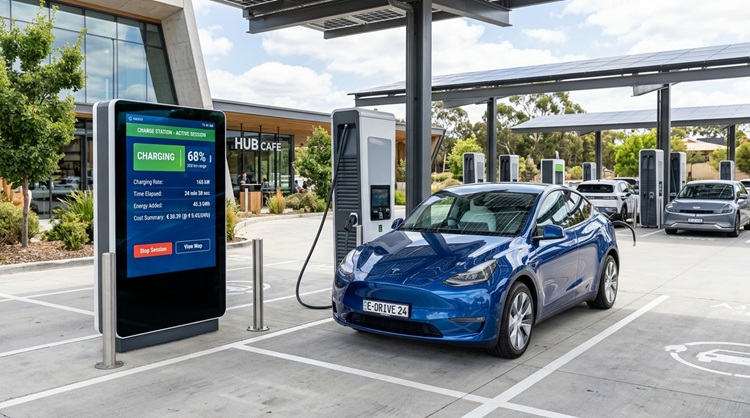

If you reside in an apartment that lacks a driveway, public charging is not an alternative; instead, it is your sole recourse. This fundamentally changes the economic rationale for electric vehicle (EV) ownership, but most of the guidance available is written for someone who has the ability to charge at home every evening at 7p per kWh on a smart tariff. This guide is written for everybody else.
The Pavement Gap: Urban Drivers Pay More by Default
There is a real financial gap between EV drivers in the suburbs and the city, and it’s growing, fast. Charging at home is VAT-rated at 5%. Public charging? Every session, every network, it’s 20 percent. The same rate you’d pay when you treat yourself to a luxury purchase. Before you’ve even got near the network’s margin, you’re already paying four times the VAT rate of someone who charges at home. Then there’s the marginal energy cost. Household electricity in the UK is currently running at 24.5p per kWh under the standard price cap.
A rapid public charger will cost you around 79.79p per kWh. An ultra-rapid will be 81.07p per kWh (RAC ChargeWatch). That’s not a small premium. At those rates, the cost per mile in an EV starts to nudge the cost per mile in a modern petrol car. This is what’s sometimes described as the pavement gap, the structural financial penalty imposed on apartment-dwellers in the urban environment who cannot charge at home or on the street.
It isn’t going away fast, but it can be managed. The people for whom urban EV ownership is truly financially compelling aren’t the ones in the best car or with the best app. They’re the ones for whom charging represents a financial decision rather than a logistical one.
Using Retail and Destination Charging Tactically
Many large businesses are starting to provide EV chargers for free to their customers and incentivizing their employees to do the same. Supermarkets, shopping centers, gym chains, and hotels now offer it as a customer benefit rather than a revenue stream. Pricing is below network rates, and in some cases, it’s free with a minimum spend or membership cost.
For urban drivers you can see their strategy already. Integrating charging into routes they already take, they know a weekly shop somewhere that’s 45 minutes long can put 20-30kWh in the car for basically the cost of parking. They know going and visiting the gym three times a week can throw another 20 kWh in the battery. None of those stops requires changing your life, they just require plugging in to where you already are.
And that, in turn, requires only that you look at a map and locate existing AC chargers near where you shop, cycle, dine, work, or whatever. Then even stops for ten or twenty minutes are electrically useful and virtually no more effort than stopping somewhere else near a gas station. This is also where the density of the network you are part of comes in. Localized networks in major cities are building out coverage specifically to give urban drivers access to affordable, well-located charging outside the motorway service station model. Regional infrastructure like manchester ev charging hubs is an example of this, purpose-built urban charging that sits within the city rather than on arterial routes, making destination-based charging genuinely viable for residents without home charging access.
AC vs. DC: The Cost Per Mile is Not the Same
Not all public chargers have the same cost or performance. There are two kinds: AC charging (7-22kW) and DC charging (150kW and more). AC charging is slower but much cheaper kWh-wise. These chargers are often subsidized by the place where they are installed since they do not aim to make money out of the charging session but rather provide an added service for their customers. Supermarkets, gyms, hotels and petrol stations are some examples of places where you could find this type of charger.
On the other hand, DC chargers are the ultra-fast chargers you probably have heard of. They are designed to give you 100 miles of range in less than 20 minutes. These chargers should be the ones you look for if planning on making a long trip. They are usually more expensive when it comes to the per kWh rate.
For everyday driving, the cheapest way to charge is using an AC destination charger. This is the type of charger you will leave connected to your car while you go for a swim, to the supermarket or leave it charging overnight near your apartment. Next time you’re in a mall make sure to look around the car park, they are even usually cheaper.
The 80% Rule and the Charging Curve
This is perhaps the most valuable technical knowledge for any public charging user, and it’s something most of us are bad at applying.
EV batteries don’t charge at a consistent rate. They follow a charging curve. They charge quickly when nearly empty and more slowly as they get full. For most EVs, the rapid part of the charge curve tapers off somewhere around 75%-80% State of Charge. Then you might be drawing a tenth or a twentieth of the power from the charger that you were when you began. By the time you’re at 90%, you might be charging at 1kW, a fraction of the headline speed of a 50kW charger. But the charger’s billing you for 50kW.
If you’re on a per-minute tariff, sitting at a rapid charger above 80% SoC is the single most expensive thing you can do. You’re paying rapid charger rates for slow charging. If you’re on a per-kWh tariff, sitting in a bay above 80% SoC while other people need to charge can trigger an overstay fee on top of the energy cost.
The simple rule is that you should always plan to charge to 80%, not 100%. You’ll pay less for every charging session and you’ll avoid overstaying and the associated penalty entirely.
Hidden Fees That Catch Metropolitan Drivers Out
Parking charges are the most common one. In many urban locales, the charging bay is located within a paid car park. The charge for charging and the charge for parking are billed separately, by separate systems, often by separate companies. Not uncommonly, you can leave what appeared to be a 45p per kWh charger having paid the equivalent of 75p per kWh.
Overstay fees, sometimes referred to as idle fees, are a separate charge. If your car remains in the bay after your charging session has ended, many networks start billing you per minute. This is to prevent bay hogging, which is a real issue in certain busy locations. The risk for drivers is the danger of simply forgetting to move your car after charging has completed, particularly if you’re charging while parked at work or while shopping.
The solution here is simple: turn on charging notifications in your car or in the network’s app, set a reminder, and simply treat the end of your car’s charging session as a time to be somewhere.
The Maths Behind Network Subscriptions
Most major charging networks offer a monthly subscription that reduces the per-kWh rate in exchange for a fixed fee. Whether that’s worth it depends entirely on your usage, and most drivers don’t work it out properly.
Here’s a simple framework. Take the subscription cost per month. Divide it by the per-kWh saving the subscription gives you compared to the pay-as-you-go rate. That gives you the number of kWh you need to charge through that specific network each month just to break even. If your realistic monthly usage on that network is higher than the break-even figure, the subscription saves you money. If it’s lower, you’re paying for the privilege of the lower rate without using it enough to benefit.
A few things distort this calculation in practice. Roaming agreements, partnerships that let you access multiple networks through a single account or RFID card, change the picture because your subscription covers more than one network’s chargers. Services like Octopus Electroverse aggregate access to multiple networks under one billing relationship, which means your mileage is spread across a larger pool of chargers. If you drive high mileage in a city and rely entirely on public charging, a roaming-capable subscription is often worth running the numbers on.
Battery Preconditioning: The Free Performance Boost
Cold weather is brutal for rapid charging speeds. A battery that hasn’t been warmed to its optimal temperature range will reject high charge rates, regardless of what the charger is capable of delivering. In practical terms, a cold battery might accept 50kW at a charger rated for 150kW. You’re paying for a rapid session and getting a slow one.
Battery preconditioning is the solution. Most modern EVs allow you to set a destination charger in the navigation system, and the car will warm or cool the battery while you’re still driving, so it arrives at the charger in the right temperature window. Some cars do this automatically; others need it configured. Check your vehicle’s manual or app.
This matters financially because it reduces the total time you spend on a rapid charger to reach your target SoC. Less time at the charger means a lower session cost on time-based pricing, and less risk of triggering overstay fees.
Time-of-Use Pricing on Public Networks
The public charging sector is simply more and more applying the same off-peak pricing logic that home tariffs have done for decades. Some networks now offer truly low rates during late night and the early morning, typically between 11pm and 6am. For city drivers, particularly those who park on-street or in overnight car parks, this changes the math.
A car left charging at an overnight off-peak public rate will never beat the home charging economics, but it comes a lot closer. Combining that off-peak public with destination AC sessions through the day offers urban drivers a dual-track approach to managing the average cost per kWh across the month.
It only requires the tiniest of habit shifts, plug in before bed rather than when you get home. In areas where on-street residential charging or overnight car parks have installed AC chargers with time-of-use pricing, this is now a practical option rather than a theoretical one.
Closing the Gap
Urban EV ownership is more expensive than the brochure suggests when you have no driveway. The pavement gap is real, the tax disparity is real, and rapid charger rates can absolutely erode the fuel cost savings that make EVs attractive in the first place. None of that means it isn’t worth it, it means it requires more thought than plugging in at home does. Drivers who build a deliberate charging strategy around AC destination sessions, the 80% cutoff, off-peak windows, and smart subscription choices consistently pay far less than those who rely on whatever rapid charger is nearest when the battery gets low. The infrastructure is getting better. The economics can already work.