
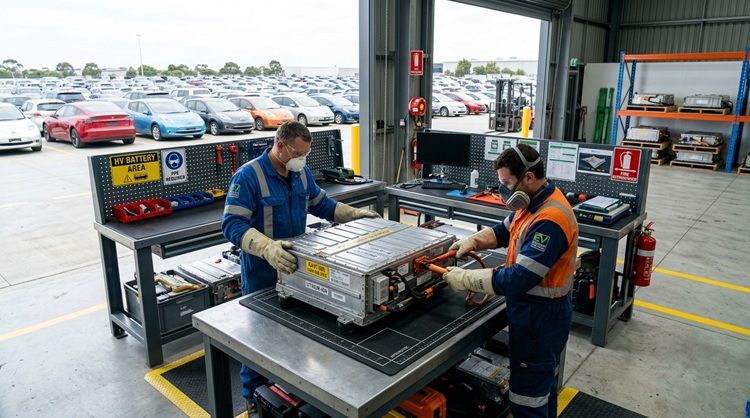

When a hybrid is brought to a yard, a worker first uses a multimeter to measure voltage at the voltage check points usually located underhood. Then he walks to the back with a set of battery terminals to hook up to the common point of the high-voltage battery, ready to discharge it if necessary. Currents are measured to ensure that no high voltage is present. Most, but not all, hybrids send a signal to the battery contactor to disconnect the high-voltage lines in the event of a crash or if the car has been powered down for 30 minutes.
The first job is making the car safe, not stripping it
Before we even think about taking a panel off or tagging a part for removal, a hybrid gets isolated. The Corolla Hybrid’s pack runs at about 243 volts, and that’s a whole different beast to the 12 volt system most mechanics grew up working around. The first physical job is to pull the orange high-voltage service plug, a bright warning totem by design. Then you wait for the capacitors in the system to discharge, before confirming zero voltage with a certified meter across multiple points. Miss that out, or rush it, and people get hurt.
This isn’t optional caution wearing a procedure disguise. A shunted battery uses a lot of copper and with a car that’s been in a collision there’s wiring that can get damaged or a case that’s compromised, and unless every technician knows for sure there’s no current running through, they all have to play safe. After that check, then, and only then, it goes into general dismantling.
Where the real profit sits, and why general scrap yards lose out
Here’s the part that surprises a lot of people: the body panels, glass, and trim on a hybrid aren’t where the money is. The value is in the powertrain. Battery pack, inverter, DC-DC converter, and the eCVT transaxle together make up Toyota’s Hybrid Synergy Drive system, and a yard that can pull all four, test them, and sell them as verified working components earns far more than one that just strips the car for scrap metal weight.
This is also exactly why general-purpose scrap yards tend to lose money on hybrids relative to what a specialist operation makes. A scrap yard sees a car with a battery it doesn’t know how to test, doesn’t have containment for, and can’t confidently sell – so it either refuses the vehicle or processes it at a loss, treating the whole hybrid system as a liability rather than an asset. A specialist yard doing proper Corolla Hybrid Wrecking will pull the battery, inverter, and transaxle as a matched set, test each one, and price them individually based on condition. That’s the gap between a yard that treats a hybrid like a normal car and one that treats it like what it actually is – a car with several thousand dollars of testable, sellable electronics sitting where a normal fuel tank would be.
Consumers searching specifically for hybrid wrecking services already sense this. They’re not looking for the cheapest tow-away offer. They’re looking for a yard that can actually pay fair value for the parts that matter and handle the dangerous ones properly.
Testing the battery before deciding its fate
Once the car is safe, the battery isn’t just ripped out and thrown away. It gets checked. A read from the Battery Management System reads state of charge and provides an overview of the pack’s health. From there the yard runs a State of Health assessment, which determines pretty much everything else from there.
A pack that’s in good shape isn’t scrap – it’s inventory. A healthy used Corolla Hybrid pack can sell for somewhere between $1,500 and $2,500 AUD as a tested unit, or slightly less as a rebuildable core for someone else to complete. That’s a reasonable amount of cash hiding inside what resembles, from the outside, a plastic-covered slab under the back seat. No yard serious about margins is going to guess at this. They test first, then decide whether the pack gets sold whole, rebuilt from good modules, or broken down for material recovery.
Why modules matter more than the whole pack sometimes
Toyota built these packs to be serviced, not just replaced outright. The individual modules inside the pack can be tested and swapped independently, which means a yard doesn’t have to treat one weak cell as a reason to write off the entire unit. If eight of ten modules test strong and two are failing, the strong ones get pulled, tested again, and sold or reassembled into a rebuilt pack. The two weak ones go into the recycling stream. This modular approach is a big part of why a specialist operation can offer a warranty on a used pack when a general yard couldn’t even tell you if it works.
Chemistry changes the whole recycling pathway
Not every Corolla Hybrid on the road has the same battery inside it. Most pre-2023 models in Australia shipped with Nickel-Metal Hydride packs, while newer models moved to Lithium-ion chemistry. This matters a lot once a pack is beyond saving.
NiMH packs are relatively easy. The packs can be discharged, mechanically shredded, and smelted without the more sophisticated processes and precautions that lithium chemistry demands. Li-ion packs must be processed using one of two industrial recovery processes: pyrometallurgical treatment (a form of high-temperature smelting) or hydrometallurgical treatment (acid leaching, with lithium, nickel, and cobalt recovered in separate streams). Hydrometallurgical recovery achieves a higher material recovery rate, but it is a slower and more technically involved process. In either case, the recycling facility needs to know exactly which chemistry it is dealing with before the pack arrives in a shipment because it’s simply wasteful with pyro-treatment, and against some recyclers’ licensing conditions to accept chemistries they’re not permitted to process.
The fire risk nobody talks about
Cells don’t die when mechanically damaged, a pack that’s been in a crash, even one with a seemingly healthy case, can develop an internal short and begin to thermally run away hours or days later. Any hybrid pack with visible impact damage or swelling, or with an unclear diagnostic history is regarded as a suspected internal short and is immediately placed into fire-rated containment.
That containment usually comprises a suitable steel drum or sand-filled bin, possibly even a purpose-built cage, and is stored at least 3 meters from all sides of every other vehicle and fuel source. That second stipulation alone should lead you to question whether you should really be storing or working on bins full of unstable lithium cells under the same roof as customer vehicles.
Second life for batteries that still have plenty left
Not every retired hybrid pack is done being useful once it comes out of a car. Industry research widely cited by BloombergNEF and battery analysts puts the typical retirement point for automotive batteries at 70-80% of original capacity, which sounds low until you realize that’s still a lot of usable storage. A pack sitting at 50-80% state of health isn’t scrap – it’s a candidate for second-life energy storage.
Refurbishers buy these packs for home solar setups and off-grid battery banks, where the discharge demands are much gentler than what a moving vehicle asks of a battery. This gives wrecking yards a direct business-to-business sales channel that pays considerably more than what they’d get sending the same pack to a metal recycler. It’s one of the clearest examples of how hybrid wrecking has shifted from a disposal problem into an actual revenue stream over the last several years.
The economics here also move with commodity prices. Cobalt and nickel recovery values, along with swings in lithium pricing, all factor into whether a yard leans toward selling a pack into second-life storage or shipping it for material recovery instead. When commodity prices are up, recycling looks more attractive. When they’re flat, second-life resale usually wins out.
Regulation isn’t background noise here
There is no scenario when all of this disappears. The depollution of an end-of-life vehicle, including fluid draining, airbag removal, and high-voltage battery processing, is a regulated process, not a courtesy. State EPAs like those throughout Australia, including EPA Victoria, decree exactly how damaged battery packs must be stored, labelled, and ultimately disposed of or consigned for recycling. It’s not just a bad look to get that wrong – it’s a fine-generating offense for an unlicensed operator.
There is also the question of how the car arrived at the yard in the first place. Many hybrids arrive as insurance write-offs, and in many states, there are restrictions regarding what parts of a statutory write-off you can legally sell. A yard that understands both the environmental requirements and the write-off resale limitations is playing a different game to one that’s just moving metal off its lot.
What this means if your hybrid ends up in a yard
When your Corolla Hybrid write-off heads to salvage, how it’s treated speaks volumes about who’s doing the recycling. A car that’s torn apart by an untrained person in an uncontained environment is more than just a wasted battery – it’s an unsafe battery sitting in a yard. A car that’s treated by a professional is properly isolated, tested component by component, then streamed into either the resale, rebuild, second-life storage, or material recovery process that accurately reflects what’s on the car.
The orange plug, the diagnostic scan, the fire-rated bin, the module-by-module test – none of it is show. It’s the difference between a yard that can offer you a fair price on a hybrid and a yard that’s just hoping for the best when they cut under the back seat.